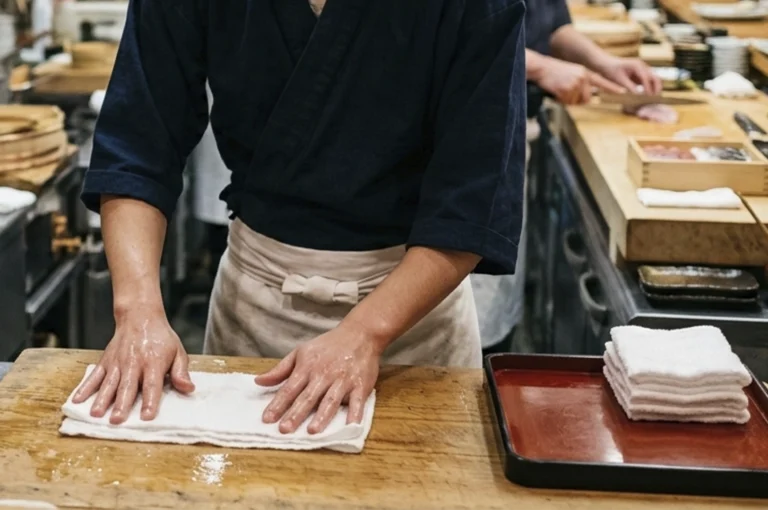
I watched the apprentice in the far corner of the room while the master prepared the opening course. The young man stood in silence beside a deep wooden basin. He held a stack of plain white cotton cloths. He took one from the top, submerged it in warm water, wrung it out tightly, and began to fold. He brought the opposite corners together, smoothed the damp fabric flat against the heel of his palm, and folded it over once more. He placed the neat square onto a small lacquer tray. Then he picked up the next cloth and repeated the sequence without a single wasted motion.
I stopped watching the cutting board and focused on his hands. I lost count after the twelfth towel. Every single one was identical. The corners met with absolute precision. The thickness of the folded stack grew steadily but never shifted out of alignment.
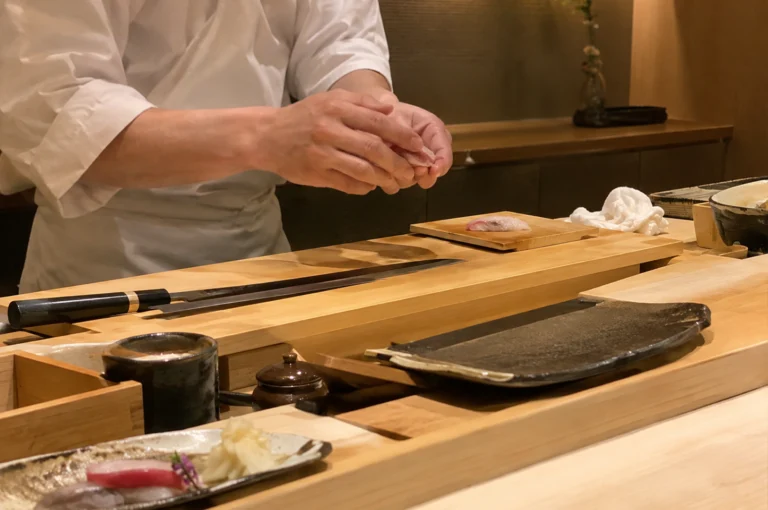
It was an obscure detail in a space built to command attention elsewhere. The solid cypress counter glowed under the warm overhead lighting. The wooden boxes behind the glass held pristine blocks of seafood pulled from cold waters earlier that morning. The entire evening was constructed around the gleam of sharp steel and the delicate balance of seasoned rice. Yet I found myself completely captivated by that small tray of damp cotton.
We instinctively praise the final creation resting on the ceramic plate. We marvel at the rich color of the tuna and the delicate scoring on the silver skin of the gizzard shad. We applaud the decades of mastery required to deliver a single perfect bite. But beneath the surface of that artistic achievement lies a rigid foundation of invisible repetition.
A folded towel is not meant to dazzle the guest. It is an internal standard. A cloth used to wipe a wet cutting board or clean the residue from a knife blade will become stained and useless in a matter of minutes. Affording it such mathematical perfection feels almost futile to an outside observer.
Except perfection is exactly the point. The attention given to the most mundane chore dictates the rhythm for the entire kitchen. If an apprentice is allowed to tolerate sloppy edges on a cleaning cloth, that leniency might eventually bleed into the temperature of the rice or the angle of a cut. The unwavering discipline required to treat a humble piece of fabric with profound reverence is the very same discipline required to handle a precious ingredient.
The master reached out a hand without taking his eyes off the fish. The apprentice instantly placed a freshly folded towel onto his palm. The master wiped the long blade in one smooth draw and set the cloth aside. Its perfect geometry was already undone by the moisture and the work.The apprentice stepped forward and quietly cleared it away. He returned to the wooden basin and picked up another cloth from the immaculate stack. He smoothed the fabric flat against his palm, brought the corners together, and waited.