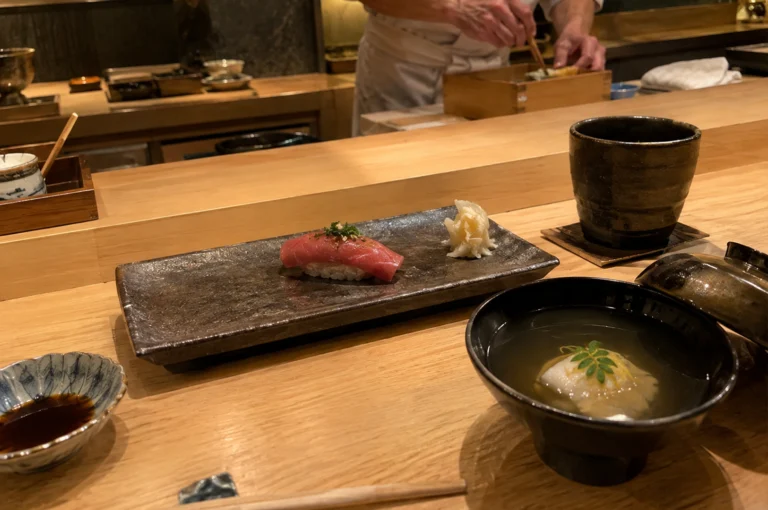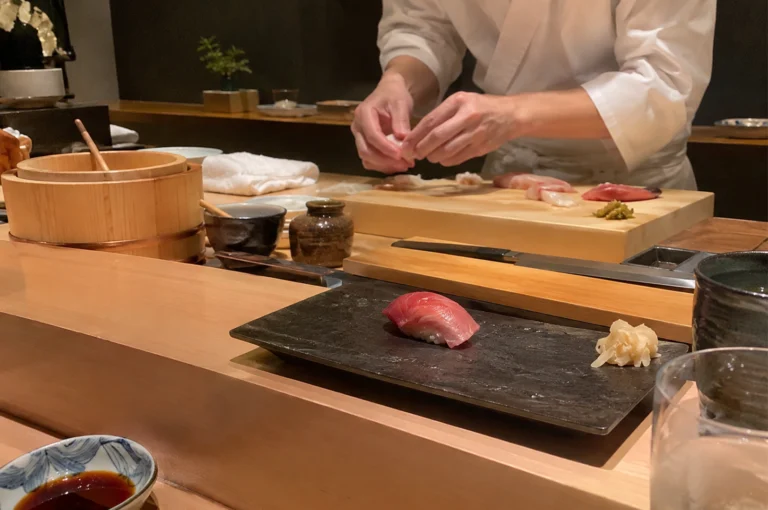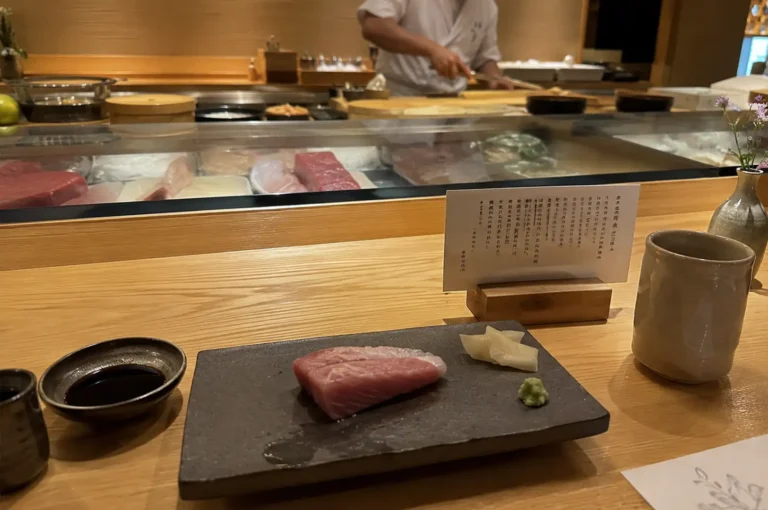
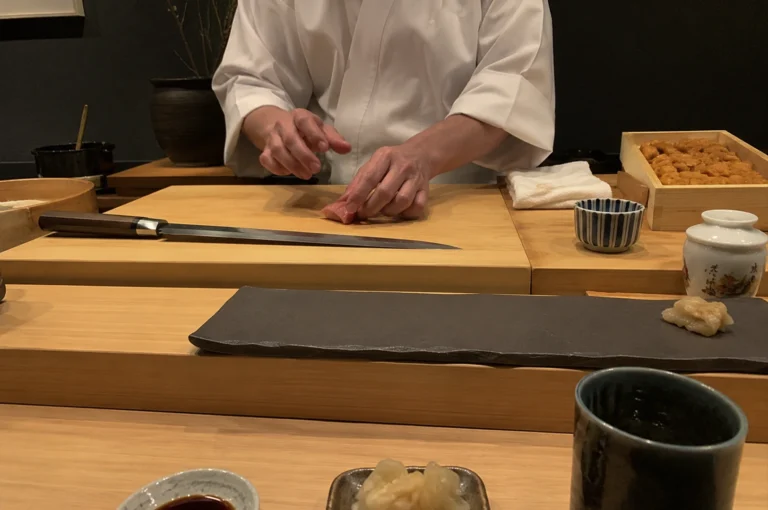
The first thing I noticed at the omakase counter was not the fish.
It was the movement.
Or more specifically, the absence of wasted movement.
The chef never reached twice for the same tool. A towel folded neatly to the side was picked up and returned to the exact same place. The knife moved with quiet precision, never dramatic, never rushed. Even the way a piece of sushi was placed in front of a guest felt measured down to the smallest angle.
Nothing touched the counter without purpose.
In most restaurants, motion fades into the background. Plates arrive quickly, servers weave between tables, conversations overlap, and kitchens pulse with visible urgency. But at a Japanese omakase counter, movement becomes part of the meal itself.
You begin noticing details you normally ignore.
The chef turning slightly before slicing.
The subtle pause before brushing soy sauce onto the fish.
The exact moment a ceramic plate lands softly onto wood without making unnecessary sound.
Everything feels intentional.
There is a discipline in that kind of restraint.
Japanese omakase dining often celebrates simplicity, but sitting there made me realize simplicity is not the absence of effort. It is the result of mastering it so completely that nothing extra remains. Every gesture has already been refined, repeated, and stripped down to what is necessary.
No exaggerated flourishes.
No wasted reach.
No movement for show.
Even silence seemed carefully placed.
I remember watching the chef prepare a piece of nigiri while speaking softly to a guest. Somehow, the conversation never interrupted the rhythm of his hands. The knife moved as though it already knew where to go before the thought fully formed. Rice was shaped gently but quickly, almost like muscle memory shaped by years rather than practice.
It made me think about how rarely we move through life with that kind of awareness.
Outside the restaurant, we multitask constantly. We scroll while eating. Speak while half-listening. Reach for things absentmindedly. We fill silence immediately because emptiness makes us uncomfortable.
But at the counter, nothing felt careless.
A cup was placed down softly.
A napkin adjusted once.
A dish served exactly when it should be.
Even waiting became part of the experience rather than an interruption to it.
There is something calming about witnessing people who have learned to move with intention. Not slowly, not theatrically, just deliberately. It creates an atmosphere where guests unconsciously begin matching that energy. Voices soften. Phones stay lowered longer. People pay attention.
The economy of movement at an omakase counter is not only about efficiency. It is about respect.
Respect for ingredients.
Respect for craft.
Respect for the shared space between chef and guest.
Nothing touched the counter without purpose.
And by the end of the meal, I realized that was the real lesson being served alongside the sushi: how much more meaningful things become when done intentionally, instead of simply done quickly.